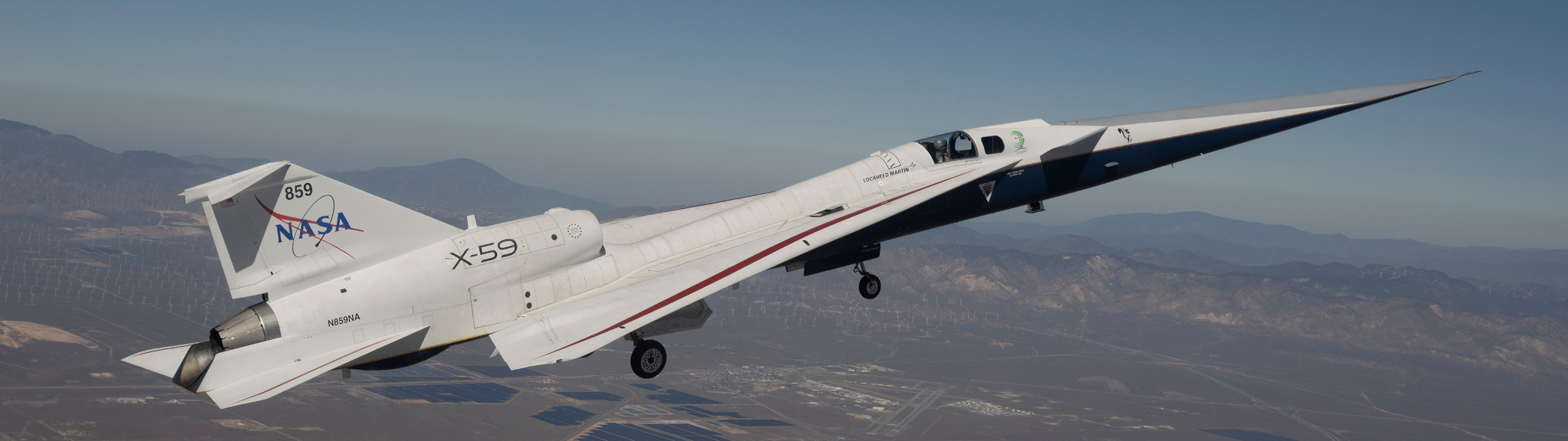
NASA quietly passed a critical milestone on June 5 when its X-59 demonstration aircraft flew faster than sound.
The X-59 is the sharp end of NASA’s QUESST programme. QUESST is the latest chapter in a multi-decade story of hard work, innovation, and good keen folks battling on in the face of adversity. Early supersonic jets rattled windows and zapped nerves, because challenges such as speed and airworthiness kept their designers fully occupied. There was little time or money for noise minimisation. The political backlash metastasised in the USA into a ban on supersonic flight over land, restricting Concorde to oceanic routes and blocking numerous other promising developments.
The ban took effect on April 27, 1973. It is still in place.
Sonic Booms are Not Inevitable
Aviation engineers knew, way back in the 1970s, how to design boom-free supersonic aircraft. Eliminating the sonic boom’s sudden shock requires a balanced combination of shape, aircraft length, weight, and operating altitude. This knowledge did not deter US federal aviation officials from banning non-military supersonic flight over land.
Fortunately for technological progress, some aviation engineers continued working toward quiet supersonic aviation, ironically financed mainly by the US Federal Government. Lawrence R. Benson’s 2014 book, “Quieting the Boom”, documents the 70-year journey leading up to the flight of the “Pelican”, a Northrop F5E fighter plane fitted with a bulging snout not unlike a pelican’s beak. Flying for NASA’s “Shaped Sonic Boom Demonstration” (SSBD) in 2003, and the follow-up “Shaped Sonic Boom Experiment” (SSBE), the Pelican conclusively proved that the sudden shock of supersonic booms from aircraft such as Concorde was not inevitable.
X-59
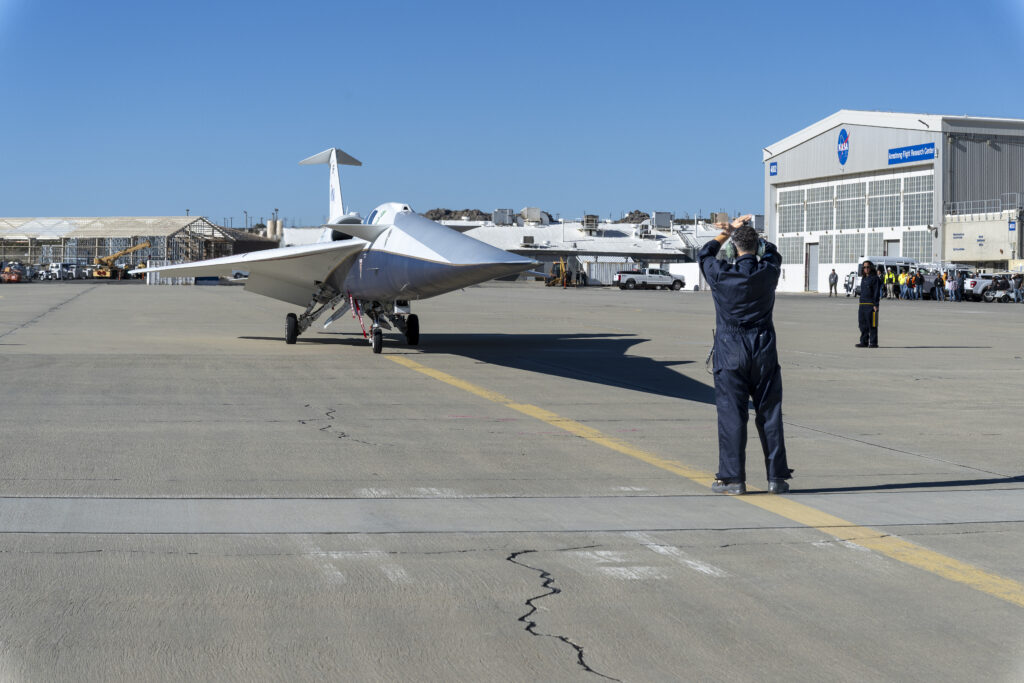
More than a decade after the Pelican proved the feasibility of quiet supersonic air travel, NASA awarded a contract in 2016 to Lockheed Martin for the X-59 QUESST (“Quiet SuperSonic Technology”) programme. The goal is to find out how people respond to the sound of a supersonic aircraft designed to eliminate the boom. People who heard the Pelican fly overhead described the sound as a “thump”, if they heard it at all. The higher the plane flies, the less sound reaches the ground. The X-59 will fly over selected areas while QUEEST researchers study how people respond to sonic thumps of various intensities. Some preliminary testing with an F-18 jet in 2018 indicated that most people aren’t bothered by quieter thumps, but loud ones can be annoying.
Will New Rules Enable Supersonic Air Travel?
The USA’s present aviation rules outlaw non-military supersonic flight if there’s a measurable sonic boom. Never mind if no-one can hear it: If it can be measured it’s illegal. Super-sensitive sound measuring equipment is a lot better and cheaper than it was in 1973. The gear keeps getting better. That’s seriously bad news for supersonic aviation.
Without a rule change, supersonic air travel over North America is a non-starter.
QUESST’s ultimate goal is to develop an objective sound level measurement that can be used for regulating noise levels from supersonic aircraft. There’s good reason to expect practical supersonic aircraft to be quiet enough not to harm people on the ground. Already, the US Federal Government is debating a Bill requiring the Federal Aviation Administration to rewrite the rules.
What Next?
Designing a quiet supersonic aircraft involves intensive testing of physical or virtual models. Designers investigated 60 variants of the Pelican’s customised nose. Their final design is probably not the ideal shape for a quiet supersonic aircraft. The X-59 shares the Pelican’s arrow-like form, but its nose looks different.
Back in 2003 virtual model testing was just getting started. CAD software in those days could produce multiple variations on a theme, but the process was messy and laborious. Designers had good reason to be skeptical of computational fluid dynamics (CFD). The limitations of CFD ensured that wind tunnel testing was mandatory. That required physical models which had to be made by hand.
In 2026 we have far better design tools. CFD analyses can usually be trusted to realistically predict aerodynamic effects. Generative AI and parametric design tools take the boredom out of creating “families” of 3D aircraft designs. 3D printers are more than capable of creating physical models for wind-tunnel testing, which remains an important part of the development process.
This is an enormous opportunity for creative engineers to drive humanity forward. It’s inconceivable that anyone has drawn the best shape. Today’s design tools make it easier to try new ideas. Weird new aircraft designs should intensify competition between airlines. Everyone wins when that happens.
Meanwhile in Washington a proposed new law called the Supersonic Aviation Modernization Act is being shuffled through the political labyrinth. The draft law would require the Federal Aviation Administration to make new rules allowing commercial supersonic aviation in the USA. The House of Representatives has passed the draft law. Late March this year, it was referred to a Senate Committee.
The QUESST programme will establish the acceptable loudness of a sonic thump. We already know aircraft like the X-59 won’t cause the kind of sonic boom that invigorated 1960s technophobia. Keen engineers hope QUESST and the Supersonic Aviation Modernization Act lead to realistic rules for commercial supersonic air travel.
We are technorg.
Further reading: Lawrence R. Benson: “Quieting the Boom”.
Images in this post supplied by NASA