That burning smell as you drive down a steep slope might not be coming from a roadside barbecue just around the next corner. More likely, it’s your trailer or caravan brakes.
Highways in New Zealand are getting steeper. Wellington’s Transmission Gully (SH1) has two steep bits (6% slope, or gradient), and two very steep bits with 8% gradient. The new Ashhurst to Woodville section of State Highway 3 (SH3), which replaced the abandoned Manawatu Gorge, is even steeper.
Heading over the Ruahines from Woodville to Ashhurst on SH3 there’s a long steep curved downhill where the road drops ten metres for every 100 metres horizontal travel (That’s a 10% gradient). A sign at the top says, “Trucks Use Low Gear”. On your way down the hill you pass another sign: “10% next 1.5 km.”
Steep downhill gradients pose plenty of challenges. This post will focus on how they affect brakes.
Long steep downhills wreck brakes
Long steep gradients can cause over-heating and excessive wear of the brakes on some light trailers*. Steep downhills also jack up transport costs by increasing wear and tear on trucks.
I’ve seen how this works. Riding over SH3 from Woodville to Ashhurst, in a late-model Mack hauling a B-Train loaded to a total (gross) weight of 50 tonnes, I watched a driver using his engine brakes to hold a steady 33 km/hr down the steep curve toward Ashhurst. With two heavy trailers nudging the truck, you wouldn’t want to go any faster.
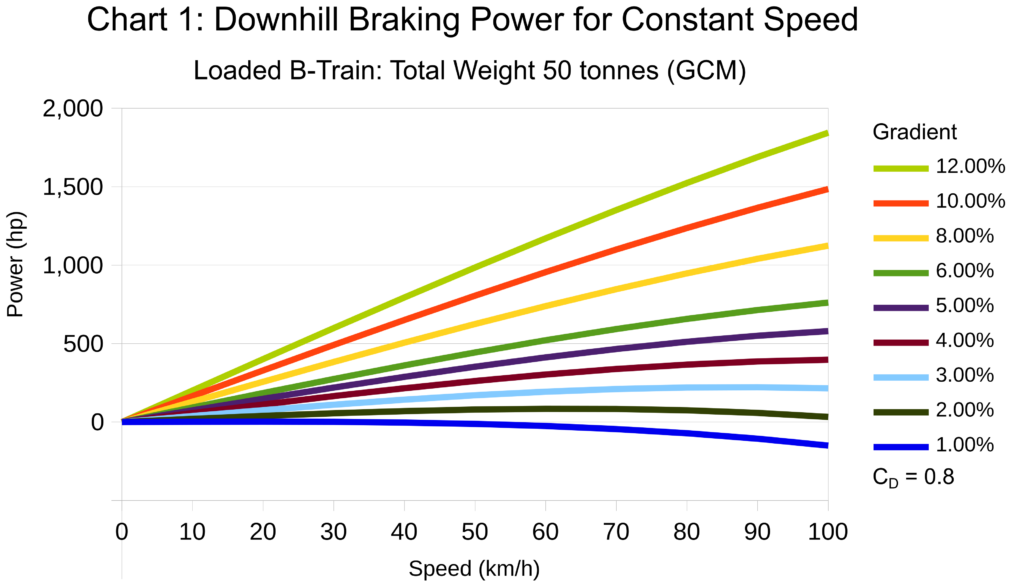
The engine brake on that Mack allows the driver to convert the engine into a heavy-duty braking system, capable of hundreds of horsepower of braking effort, without using the ordinary “service” brakes. According to my calculations (se Chart 1), at 33 km/hr the Mack’s engine brake was delivering about 500 horsepower. Downhill braking power for a truck is almost exactly proportional to speed. If we’d tried doing a steady 66 km/hr down that 10% gradient, the engine brake would need to put out about 1,000 horsepower.
If the engine brake can’t cope, the truck will speed up. And speed up. And speed up. Until the driver hits the brake pedal.
I’m aware of a driver who drove a truck over that new section of SH3 for several weeks without using the engine braking system. They burned up a set of brake linings that should have lasted many years. Fixing those brakes cost $11,000.
Light vehicles don’t get off lightly
Towing a trailer with a ute or SUV, it makes sense to avoid constant braking on steep downhills. Constant use of the foot-brake heats up the brake linings. If brake linings get too hot, they lose their grip and you get “brake fade”.
My ute does not have an engine brake: It wasn’t even available as an option. Towing my boat (approximately 750 kg) over SH3 toward Ashhurst, I use fourth gear at about 75 km/hr (The transmission has six speeds). This means slowing down to 75 km/hr at the crest of the hill, so I can engage fourth without over-revving the engine.
Trailers with over-ride hydraulic brakes can over-heat even if the driver is using a low gear. Over-ride brakes are activated by a hydraulic cylinder on the trailer’s drawbar. On a steep downhill, the trailer pushes against the towbar just enough to apply the trailer brakes. It’s as if there is no solid connection between tow vehicle and trailer: The trailer just follows the tow vehicle downhill.
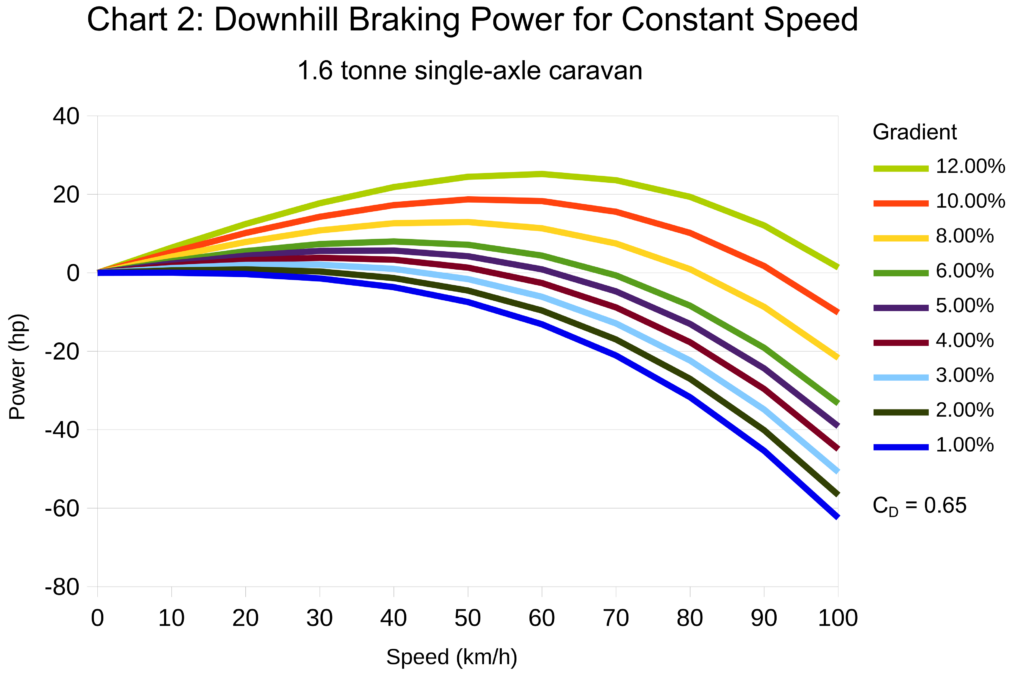
This takes us back to that burning smell. The next chart shows how much work those brakes are doing. The lines are curved, because aerodynamics affect some light trailers, especially caravans**. Air resistance tends to slow the caravan, so it would need less braking power than, say, a diesel tanker of the same weight. The brakes on the caravan modelled in Chart 2 need to put out 20 horsepower to maintain a steady 50 to 60 km/hr going down a 10% gradient. All that braking power gets converted into heat: 7.5 kilowatts (10 hp) per wheel!
How steep highways damage the New Zealand economy
Transport operators using steep highways face the cost of massive wear and tear on trucks and trailers. They have no choice but to increase freight charges. Steep highways drive up the price of everything.
Steep downhills are potentially dangerous for light vehicles. I’m aware of one case of smoke billowing out of the wheels on a horse float at the bottom of a steep downhill. Over-heated brakes may not work when they’re needed. Worst case, they can set fire to the trailer or its load.
The mathematics behind Charts 1 and 2 show the importance of slowing down for steep downhill gradients. Towing a trailer, if you see a sign that says, “Trucks Use Low Gear”, it’s time for you to slow down too. The sooner the better, because those signs are often located well beyond the brow of the hill, where the road is already steep. If your trailer has override brakes, it makes sense to stop at the bottom of the hill to let them cool down. (They will probably be too hot to touch!) On very long downhills it might pay to stop every few kilometres.
Downhill on a steep highway, the slower you go, the lower the risk.
Why is New Zealand building steep roads?
The NZ Transport Agency’s business cases do not account for the full range of economic, social, and cultural benefits of new highways. They seriously underestimate the benefits. This drives them to cut corners, trying to reduce construction cost, because they have ignored most of the benefits.
When designing the new section of State Highway 3, for example, NZTA looked at several possible routes. If they’d taken account of all the potential economic benefits, and if they’d limited the maximum gradient to five percent, they would have built a far better road.
Steep roads are false economy.
New Zealand deserves better.
We are technorg.
* In New Zealand, a “light” trailer is a trailer with a total loaded weight of 3500 kg or less.
** In Charts 1 and 2, negative braking horsepower means the driver needs to use the accelerator to maintain the speed shown in the chart.
Click here for details of the model I used for the charts in this post.